This project is the result of my Master’s thesis, tackling a simple but tricky question: How do you design for users you rarely get to meet?
In collaboration with the digital publishing company Vitec Visiolink, I explored how personas could be developed and used to create a shared understanding of end users in a B2B2C environment, where direct access to users is limited.
Visiolink had access to user data, but much of it was indirect and fragmented. My challenge was to turn these insights into three research-based personas that could make different user groups more tangible — and give Visiolink and its clients a shared language for talking about the people they ultimately design for.
Role: UX/UI Designer & Researcher
Context: Master’s product thesis
Duration: January – June
Methods: User research · quantitative survey · cluster analysis · scenario-based evaluation
Tools: Figma · Typeform · Excel
During my internship at Visiolink, I became aware of how a traditional UX process was challenged when the users aren’t accessible to the upstream business that is designing the digital product. After reading about different business models it became apparent to me that Visiolink operates in a B2B2C environment: they build and provide digital solutions for client organizations, while the people actually using those solutions are the clients’ customers. This creates a layer between the company and its end users.
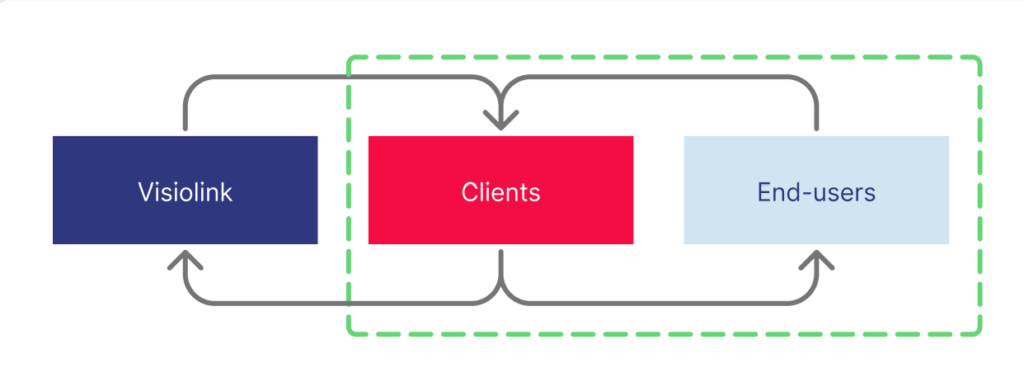
Visiolink had access to user data, but much less access to the users themselves. Insights were therefore often indirect, fragmented, or difficult to bring into client conversations.
The design question therefore became: Could personas turn this fragmented, indirect data into something people could actually use to talk about their users?
Because Visiolink already had access to data about the people using their products, The challenge wasn’t a complete lack of user knowledge. The problem was that the data existed mostly as numbers, fragments and individual insights rather than as a shared picture of distinct user groups. This led me to ask: What if I could turn those patterns into people?
Step 01 — Collect
In collaboration with Visiolink, I designed the questions to a quantitative survey, which was created via Typeform. The goal of this survey was to gather information about the end users that Visiolink could reach indirectly. This was done through interstitials, allowing the users to be a part of the research willingly, instead of forcing it on them.
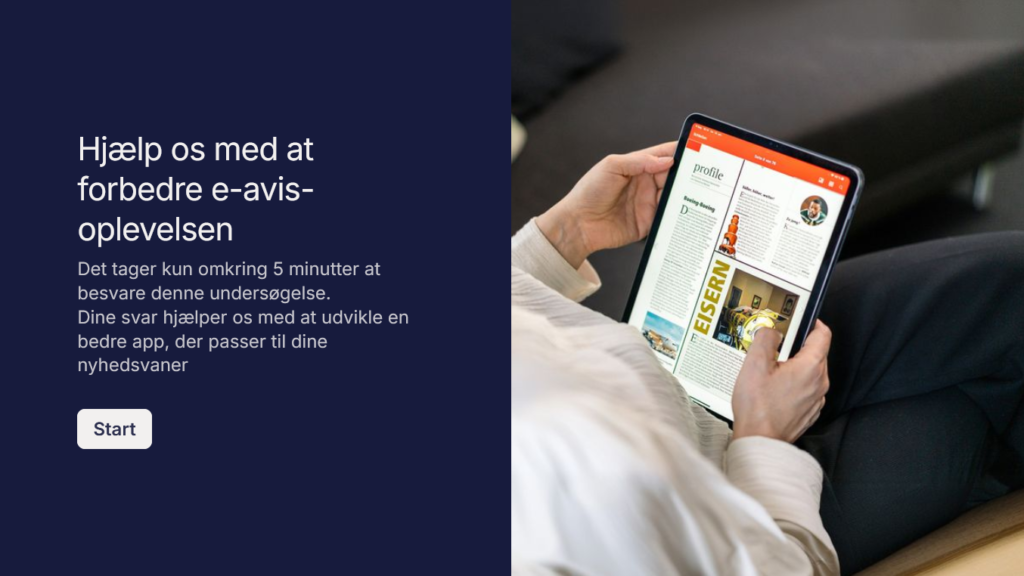
For this part, the goal wasn’t simply to collect more data. It was to find patterns in the people behind the data.
Step 02 — Find the patterns
When the data had been collected, I used cluster analysis to identify groups of users with similar characteristics, behaviors and needs. This was done by downloading the dataset into an Excel sheet, and then manually using clustering algorithms to classify the data into similar groups of user representatives, based on their similarities.
Rather than starting with fictional archetypes, the personas were grounded in the patterns found in the dataset. This resulted in three distinct e-paper user groups.
Step 03 — Give the groups a face
After identifying the clusters, they slowly helped identify three personas:
Anders – The relaxed retiree
Birgitte – The busy consumer
Christian – The morning briefer
Giving each group a name, story and recognizable characteristics made the data easier to discuss and remember. The personas weren’t intended to represent every end user. They were a way of making otherwise abstract user groups concrete enough to talk about.
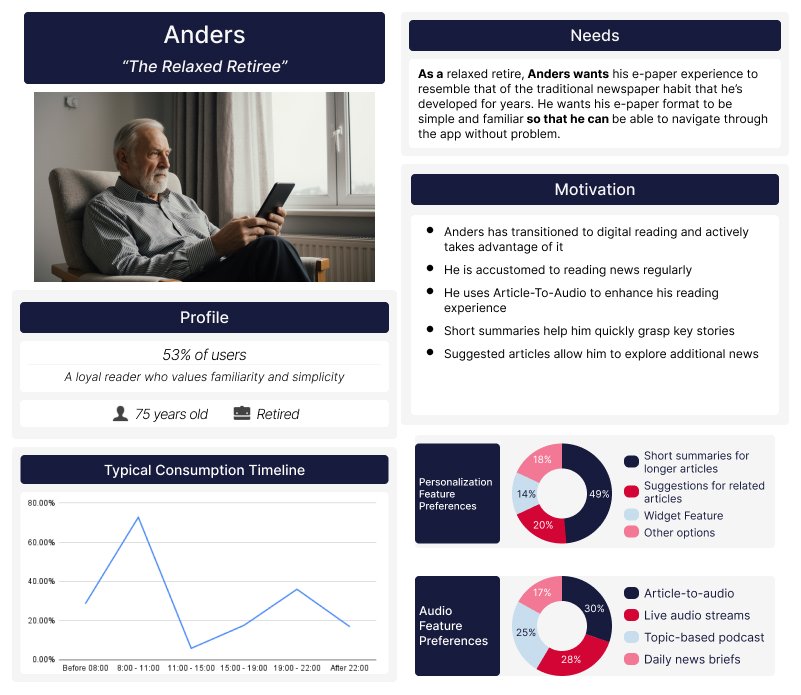
Anders — The relaxed retiree
Anders is a retired user who values familiarity, simplicity, and a relaxed way of consuming news. He tends to start his day later and enjoys using audio to complement his reading — particularly having articles read aloud.
While he prefers editorial curation over highly personalized content, he appreciates features such as short summaries and suggested articles that make it easier to discover and navigate the news.
For Anders, digital features should enhance the familiar experience — not complicate it.
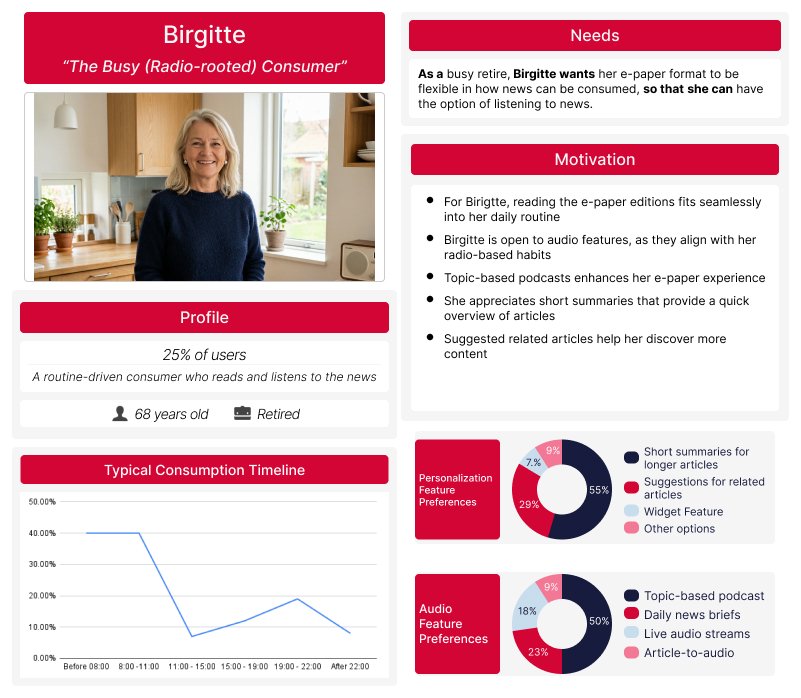
Birgitte — The active retiree
Birgitte is an active retiree who likes to start her day with the news. She combines e-paper reading with radio, making her a more active and varied news consumer than Anders.
She is particularly interested in theme-based podcasts, using audio to explore topics that interest her rather than simply complementing her reading. She also values short summaries and suggested articles, helping her quickly find content worth exploring.
For Birgitte, the news experience is about staying curious, informed, and connected to the topics that interest her.
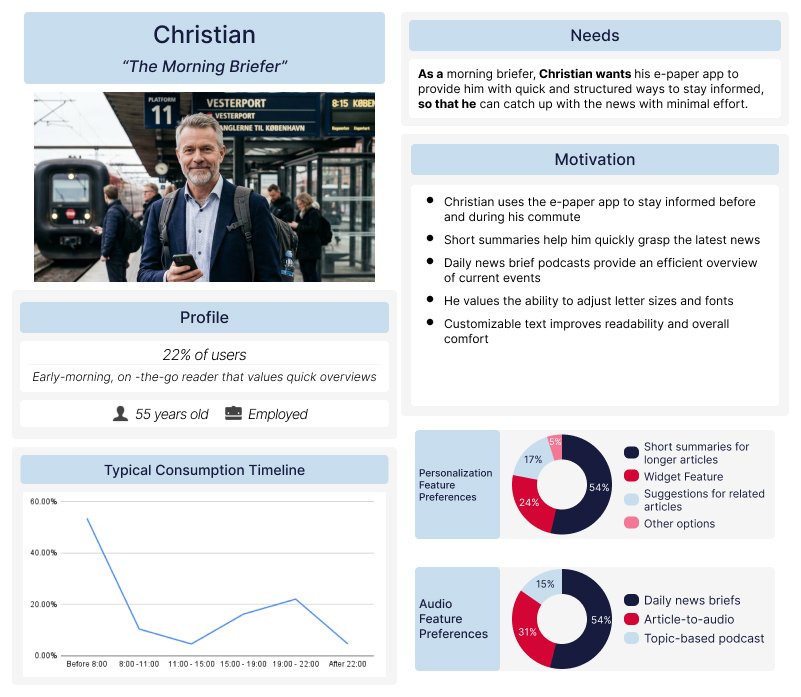
Christian — The morning briefer
Christian is the youngest and only employed persona, fitting news consumption into his busy morning routine and daily commute. He typically engages with the app early in the day and uses audio while traveling to and from work.
He values quick and accessible ways to stay informed, with a strong preference for short article summaries and daily news briefings that help him get an overview without spending too much time. He also appreciates being able to adjust the reading experience, such as changing font size and style.
For Christian, the news experience is about getting the right information, at the right time, wherever he is.
For my thesis, the real question became whether these personas could actually be used. I brought the personas into a scenario-based exercise with Visiolink employees to explore how they could support conversations about end users.
Instead of asking: “What do we know about our users?”
The personas gave participants something more tangible to discuss:
“How might Anders experience this?”
“Would Birgitte have the same need?”
“What would Christian expect here?”
The personas turned user data into something participants could point at, question and discuss together.
The project showed me that personas can become dialogue tools by giving different people something concrete to discuss when talking about users, their needs and their behaviors.
In a B2B2C context, this became especially valuable. Rather than trying to create a definitive picture of the end user, the personas helped Visiolink and its clients build a shared picture together. Overall, the takeaway from my journey developing these personas and writing my master thesis can be summed up in the following key insights:
#1 – Indirect data can still tell a story
Limited access to users doesn’t necessarily mean limited user insight. By collecting data through surveys and identifying patterns across user groups, I was able to create personas from an otherwise fragmented dataset.
However, the process also showed that the quality of the persona depends on the quality and focus of the data behind it. With broad quantitative data, interpretation becomes an important part of connecting the dots — meaning personas should be treated as informed representations, not objective truths.
#2 – Context makes the persona useful
The personas worked best when they had a clear purpose. Their value became particularly apparent in situations, where they could help shift the conversation from abstract data to specific users. Due to the limitation of the thesis, I wasn’t able to evaluate these personas in real-life settings, with real clients. But by conducting a scenario-based exercise, Visiolink’s employees gave me valuable insights into what these types of situations could look like, such as workshops, pitch meetings and client conversations.
#3 – The biggest takeaway
I started the project thinking personas could help Visiolink overcome its limited access to end users. I ended up seeing them differently. The role of the persona wasn’t to replace direct access to users, but to make indirect access more useful.
By turning fragmented user insights into a shared representation, personas could help Visiolink and its clients have more meaningful conversations about the people they ultimately design and create value for.